
How to Choose the Right ELCB Circuit Breaker?
Choosing the right Elcb Circuit Breaker is not merely a matter of matching amperage. It is a practical safety decision involving leakage current, installation conditions, equipment sensitivity, and expected fault levels. A device that looks suitable on a specification sheet may still trip unnecessarily in a humid workshop or fail to protect modern electronic loads.
The International Electrotechnical Commission’s IEC 60364-4-41 standard emphasizes automatic disconnection and additional protection against electric shock. NFPA’s Electrical Safety in the Workplace research also links effective protection with proper equipment selection, inspection, and maintenance. Market research from Grand View Research estimates that the global circuit breaker market will continue expanding through 2030, driven by grid upgrades, industrial automation, and renewable energy systems. Growth creates more choices, but not always clearer choices.
Electrical safety author John Cadick stated, “Electrical safety is not an option; it is a requirement.” His point remains useful here. Select the rated voltage, current, pole configuration, breaking capacity, and residual operating current carefully. Type AC may suit simple alternating loads, while Type A or Type B can better support electronic equipment, solar inverters, or variable-speed drives. The wrong type can cause nuisance trips.
Real installations are rarely perfect. Cable length, temperature, dust, moisture, and shared neutrals can change performance. This guide explains how to compare an Elcb Circuit Breaker against the actual risks, standards, and load characteristics of your project. One detail is easy to overlook: an ELCB cannot compensate for poor earthing, damaged insulation, or careless maintenance. Good protection starts with honest assessment.
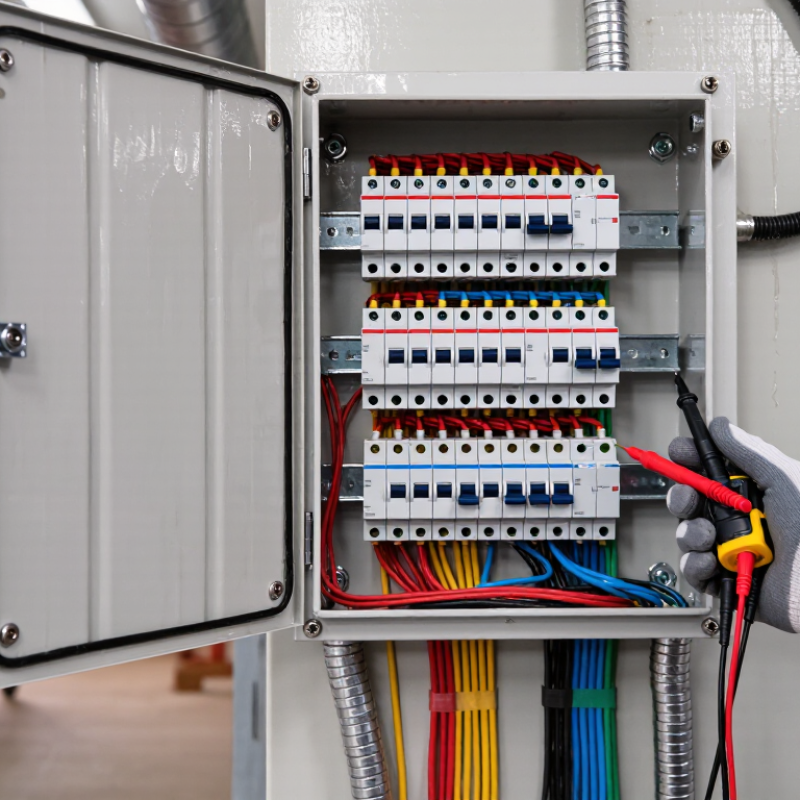
Understanding What an ELCB Circuit Breaker Does
How to Choose the Right ELCB Circuit Breaker?
Understanding What an ELCB Circuit Breaker Does
An ELCB protects people by interrupting a circuit when electricity leaks toward earth. Modern devices usually compare current flowing through live and neutral conductors. An imbalance signals leakage, and the device trips within milliseconds. Older voltage-operated ELCBs detect voltage on the earth conductor. They are less common today. That distinction matters.
The U.S. Consumer Product Safety Commission has reported that GFCI protection could prevent more than two-thirds of household electrocutions. Electrical Safety First states that a 30 mA residual-current device can reduce fatal electric-shock risk by up to 90%. These figures describe similar residual-current protection, not every ELCB installation. Performance still depends on wiring, testing, and correct selection.
A practical choice starts with the leakage-trip rating. A 30 mA device is commonly used for additional personal protection, subject to local electrical rules. Higher ratings may serve fire protection or equipment circuits, but they may not protect a person adequately. Check the device type for modern loads, including inverters, electronic power supplies, and variable-speed equipment. Confirm its breaking capacity, pole arrangement, enclosure rating, and coordination with upstream protection. The test button should operate regularly according to the manufacturer’s instructions. It is easy to trust the label too much. An ELCB cannot correct damaged insulation, poor earthing, or careless maintenance.
Identifying the Electrical Protection Requirements
How to Choose the Right ELCB Circuit Breaker?
Identifying the Electrical Protection Requirements
Choosing an ELCB starts with the actual electrical hazard, not the breaker’s appearance. An ELCB, commonly used to describe an RCD or RCCB, detects leakage current and disconnects the circuit quickly. It does not replace overload or short-circuit protection.
Begin with the earthing arrangement, system voltage, load current, and expected leakage. IEC 60364-4-41 recommends additional residual-current protection for many socket outlets and higher-risk locations. A 30 mA device is widely selected for personal protection, while higher ratings may reduce nuisance tripping in equipment circuits. The correct choice depends on the installation design.
Data supports careful selection. The U.S. Bureau of Labor Statistics recorded 126 fatal occupational injuries involving electricity in 2022. That figure does not measure every shock or near miss. Still, it shows why protection must be planned, tested, and documented. Field experience also reveals a common mistake: selecting sensitivity before checking normal leakage from filters, heaters, or long cables.
Tips: List every connected load before choosing the device. Confirm its pole count, rated current, residual-current type, and breaking capacity. Test the unit with its test button after installation, then follow the inspection schedule required by local rules. If nuisance trips continue, investigate insulation faults instead of simply fitting a higher rating. That shortcut can hide danger.
Comparing ELCB Types and Operating Principles
How to Choose the Right ELCB Circuit Breaker?
Comparing ELCB Types and Operating Principles
Choosing an ELCB starts with understanding how it detects danger. A voltage-operated ELCB monitors voltage between exposed metalwork and earth. If leakage raises this voltage, the device disconnects the circuit. This older design can be affected by poor earthing. It may also fail to detect leakage that bypasses its sensing path.
Modern installations commonly use current-operated protection, often called an RCCB or residual-current ELCB. It compares current flowing through the live and neutral conductors. Under normal conditions, both currents match. A damaged cable, wet enclosure, or person touching a live part can create an imbalance. The device then trips, often within milliseconds. That response is more dependable when the earthing system is correctly designed.
An RCBO adds overcurrent protection to residual-current protection. It can protect one circuit from leakage, overload, and short circuit. This may simplify fault finding inside a crowded distribution board. Select the trip sensitivity according to the circuit and local electrical rules. Lower settings can improve personal protection, but nuisance tripping may increase. Check the rated current, pole arrangement, breaking capacity, and AC or pulsating-DC compatibility. Press the test button regularly, and investigate every unexpected trip. In field work, labels are sometimes unclear, and terminology differs between regions. A qualified electrician should verify the system before replacement. My practical preference is not always the cheapest device; compatibility and reliable testing matter more.
How to Choose the Right ELCB Circuit Breaker? - Comparing ELCB Types and Operating Principles
| Device or Type | Operating Principle | What It Detects | Protection Provided | Selection Notes |
|---|---|---|---|---|
| Voltage-operated ELCB | Monitors the voltage between the protected installation’s earthing conductor and a reference earth. It trips when that voltage reaches its operating threshold. | Earth-potential rise associated with current flowing through the monitored earthing path. | Can disconnect a circuit when a qualifying earth fault raises the monitored earth voltage. It does not provide overload or short-circuit protection. | An older design that depends on a suitable earth connection and wiring arrangement. It may not detect faults that return to earth by a path that bypasses the sensing arrangement; residual-current devices are more commonly used in modern installations. |
| Current-operated ELCB (RCCB/RCD) | Passes the live and neutral conductors through a summation current transformer. Under normal conditions their currents balance; an imbalance above the device’s rated residual operating current causes it to trip. | Residual current leaving the monitored live-and-neutral circuit, including current flowing to earth or another unintended path. | Provides residual-current protection. An RCCB does not provide overload or short-circuit protection and must be used with suitable overcurrent protection. | Check the required residual operating-current rating, pole arrangement, rated current, supply type, and applicable local electrical rules. “ELCB” is often used informally for this type, though RCCB or RCD is more precise. |
| RCBO | Combines residual-current sensing with an overcurrent release in one device. Residual-current imbalance and overload or short-circuit current can each cause disconnection. | Earth-leakage residual current, overload current, and short-circuit current. | Provides residual-current and overcurrent protection for the circuit it protects. | Useful where individual circuit protection and fault isolation are desired. Confirm its residual-current type, rated current, breaking capacity, pole configuration, and coordination with the installation. |
| Type AC RCD/RCCB | Designed to respond to sinusoidal alternating residual current. | Sinusoidal AC residual current. | Residual-current protection for fault-current waveforms within its specified operating characteristics. | Use only where the connected loads and local rules permit Type AC. Electronic loads can produce residual-current waveforms that require another type. |
| Type A RCD/RCCB | Responds to sinusoidal AC residual current and pulsating DC residual current. | AC and pulsating DC residual current, within the device’s stated ratings. | Residual-current protection for a broader range of waveforms than Type AC. | Often considered for circuits supplying electronic equipment, but check the equipment instructions and applicable installation requirements. |
| Type F RCD/RCCB | Designed for the residual-current waveforms specified for Type F, including certain composite-frequency currents associated with some single-phase variable-speed equipment. | Specified AC, pulsating DC, and mixed-frequency residual currents. | Residual-current protection for compatible loads and waveform conditions within the device’s declared characteristics. | Consider where equipment manufacturers or installation rules specify Type F, such as certain single-phase inverter-driven appliances. Confirm compatibility from the device and appliance documentation. |
| Type B RCD/RCCB | Designed to detect the residual-current waveforms stated for Type B, including smooth DC and specified AC and higher-frequency components. | AC, pulsating DC, smooth DC, and other specified residual-current waveforms. | Residual-current protection for applications that may produce smooth DC or other waveforms not covered by simpler types. | May be required for some converters, charging equipment, or other power-electronic applications. Select according to equipment instructions, device ratings, and local rules. |
Selection reminder: Choose the device type and ratings from the connected equipment’s instructions, the installation design, and applicable electrical standards. An RCD/RCCB or RCBO is not a substitute for correct earthing, bonding, or professional inspection.
Checking Key Ratings and Installation Compatibility
How to Choose the Right ELCB Circuit Breaker?
Choosing an ELCB means checking the installation, not merely matching a catalog number. In modern practice, many products called ELCBs are RCCBs, which detect current leakage. Under IEC 61008 and IEC 61009, verify rated voltage, frequency, current, poles, and breaking capacity. Check the residual operating current, marked IΔn, carefully. A 30 mA device is commonly selected for additional personal protection, but local regulations and circuit conditions still matter. NFPA’s 2023 report estimated 23,700 U.S. home fires involving electrical distribution and lighting equipment each year from 2015–2019. That figure deserves attention.
Tips: Photograph the existing board before purchase. Record cable size, main protection, phase arrangement, and available space. Confirm the neutral passes through the device. Never route protective earth through an RCCB. Check the manufacturer’s wiring diagram, even when the terminals look familiar. Small errors can create nuisance tripping or leave protection ineffective.
Installation compatibility also depends on leakage patterns. Type AC suits alternating residual currents, while Type A detects pulsating direct components from electronic loads. Equipment with variable-speed drives or complex power supplies may require a different type. Check temperature derating, enclosure conditions, and short-circuit capacity. Selectivity matters when several protective devices share one supply. An electrician should test trip time and residual current after installation, using calibrated equipment. I still recheck polarity and neutral continuity, because assumptions fail in crowded distribution boards. No rating table replaces a site inspection.
How to Choose the Right ELCB Circuit Breaker?
Compare rated residual operating current (IΔn) when selecting an ELCB/RCD. The correct rating depends on the installation design and applicable electrical regulations.
How to read this chart: 30 mA devices are commonly used for additional protection against electric shock. 100 mA and 300 mA devices are often selected for upstream or fire-protection applications, subject to local regulations and coordination with downstream devices. Check the circuit voltage, number of poles, rated current, residual-current type, and mounting compatibility before installation. An ELCB/RCD does not provide overload or short-circuit protection unless combined with an appropriate protective device.
Selecting a Reliable ELCB for Your Electrical System
Selecting a reliable ELCB starts with understanding what your installation needs. Check the supply voltage, number of poles, rated current, and required residual operating current. These values should match the circuit and the level of protection specified by a qualified electrician. An ELCB or residual-current device can help detect earth leakage, but it may not protect against overloads or short circuits. Confirm that separate overcurrent protection is provided where required.
Look closely at the operating environment. A unit in a warm, dusty distribution board may need different considerations from one in a clean indoor panel. Check that its documented ratings suit the installation and that it complies with applicable local standards. Compatibility matters, too: the device must work correctly with the wiring arrangement and any upstream protection. Small details count.
Ask how the device will be tested and maintained. Many residual-current devices include a test button; follow the manufacturer’s instructions and the inspection schedule set by a qualified professional. A button click is not a substitute for proper installation checks. I have seen selection discussions focus too heavily on price, and that can leave important ratings unexplored. Pause and verify them. Reliable protection depends on the complete circuit, not just the label on one component.